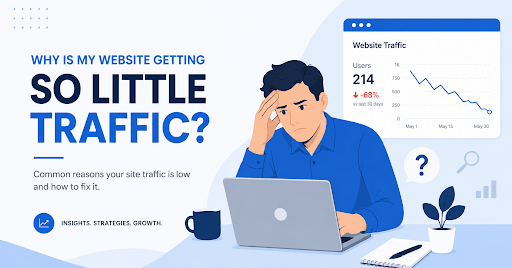
You did everything right. You built a clean website. You wrote content. You hit publish. And then — nothing. The traffic never came.
This is one of the most frustrating situations a business owner can face, and it happens more often than you think. The good news is that in most cases, the reason is fixable. And it almost always comes back to one thing: on-page SEO.
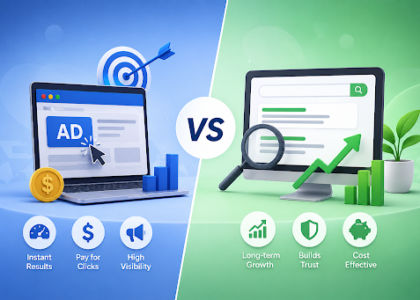
On-page SEO is the layer of optimization that sits between your content and Google’s ranking algorithm. Get it wrong, and even excellent content stays invisible. Get it right, and pages start pulling in consistent, compounding organic traffic — without paying for every click. If you have been wondering whether SEO or PPC is the better investment for your business, understanding on-page SEO first will make that decision a lot clearer.
What Is On-Page SEO and Why Does Your Business Need It?
On-page SEO is every optimization you make directly on your web pages — the title, the content structure, how fast it loads, how it reads on mobile, and how it connects to the rest of your site. Unlike off-page SEO, which depends on other websites linking to you, on-page SEO is 100% in your control. You can start fixing it today.
Think about what Google is actually trying to do. Its entire job is to serve the most relevant, most helpful result for every search. On-page SEO is how you raise your hand and say: my page is the best answer for this query. Without it, Google has no reason to choose your page over the hundreds of others covering the same topic.
The hard truth: A slow, poorly structured page with no keyword strategy will not rank — no matter how good the content is. On-page SEO is what makes your content visible.
8 On-Page SEO Problems That Are Killing Your Website Traffic
1. Your Title Tags Are Generic or Missing Keywords
The title tag is the headline Google shows in search results. It is also one of the strongest on-page ranking signals you have. If your title is vague — something like “Home” or “Services Page” — Google has almost no signal about what the page covers.
A strong title tag for a business page should:
- Include your primary keyword near the beginning
- Stay under 60 characters so it does not get cut off in results
- Be written to earn a click, not just describe the page
- Include your brand name at the end
Weak: SEO Services | Our Company
Strong: Professional SEO Services That Grow Your Traffic | Tech Tribe Mag
2. Your Meta Descriptions Are Not Written for Humans
Meta descriptions do not directly affect your rankings, but they have a massive effect on whether someone actually clicks your result. If your meta description is a list of keywords or a copy-paste of the first sentence, you are leaving clicks on the table.
Write meta descriptions the way you would write an ad headline. Lead with the benefit, include the keyword naturally, and end with a reason to click. A 5% improvement in click-through rate at the same ranking position means 5% more traffic — for free.
3. Your Content Does Not Match What People Are Actually Searching For
This is called search intent mismatch, and it is one of the most common reasons business owners watch their rankings disappear. You might rank for a week and then drop because Google sees that users are clicking your page and immediately going back — a signal that your content did not give them what they needed.
Before writing any page, ask yourself: when someone types this keyword into Google, what do they actually want? Are they looking for a quick answer, a how-to guide, a product to buy, or a comparison? Your content format and depth should match that intent exactly.
4. You Have No Internal Linking Strategy
Internal links are one of the most underused and most impactful on-page SEO tactics. Every page on your site that has no internal links pointing to it is essentially invisible — Google may not even know it exists, and it receives none of the authority built up by your stronger pages.
A solid internal linking strategy connects related content and passes authority from your established pages to newer ones. For example, this guide connects naturally to our article on how to speed up your website — because page speed is a direct on-page SEO factor — and to our eCommerce SEO guide for businesses selling products online. Each link helps Google understand the relationship between these pages and boosts the visibility of both.
Rule of thumb: every new piece of content you publish should have at least 2 to 3 internal links from existing pages, and should link out to 2 to 3 relevant pages in return.
5. Your Page Speed Is Hurting Your Rankings
Google made it official: page speed is a ranking factor. And not just a minor one. The Core Web Vitals update means Google actively measures how fast your pages load, how quickly they respond to user interaction, and how stable the layout is while loading.
According to Google’s Core Web Vitals research, a one-second delay in load time can reduce conversions by up to 7%. If your site takes more than 3 seconds to load on mobile, you are losing both rankings and revenue. You can check your current scores for free at PageSpeed Insights (pagespeed.web.dev).
6. Your Site Is Not Optimized for Mobile Users
Google uses mobile-first indexing. That means it crawls and evaluates the mobile version of your site first when deciding where to rank you. If your desktop site looks great but your mobile experience is slow, cramped, or hard to navigate, your rankings reflect that — not your desktop experience.
More than 60% of all Google searches now happen on mobile. If your site is not fast and easy to use on a phone, you are invisible to the majority of people searching for what you offer.
7. You Are Not Using Header Tags Correctly
Header tags — H1, H2, H3 — do two things simultaneously. They structure your content so readers can scan and find what they need, and they signal topic hierarchy to Google. Your H1 should appear once per page and include your primary keyword. Your H2s should cover the main sections and include secondary keywords naturally. Your H3s handle sub-points within each section.
Pages with clear heading structure consistently outperform pages written as one unbroken block of text. They are also far more likely to appear in Google’s featured snippets — the highlighted answer boxes that appear above all other results and can double your click-through rate overnight.
8. Your Content Is Thin and Does Not Demonstrate Expertise
Google’s quality guidelines use a framework called E-E-A-T: Experience, Expertise, Authoritativeness, and Trustworthiness. In practice, this means Google rewards content that clearly comes from someone who knows what they are talking about, cites real data, and gives answers that are more helpful and complete than what competitors offer.
Thin content — 300-word pages that scratch the surface of a topic — rarely ranks in 2026. In-depth, original content that genuinely answers the reader’s question and addresses the follow-up questions they have is what earns and keeps rankings.
The On-Page SEO Checklist Every Business Owner Should Run Today
You do not need an expensive tool to start. Go through your top 5 pages right now and check each of these:
- Does each page have a unique H1 that includes the target keyword?
- Is the meta title under 60 characters and written to earn a click?
- Is the meta description under 160 characters with a clear benefit?
- Does the URL slug include the keyword and avoid unnecessary words?
- Are there at least 2 to 3 internal links pointing to and from this page?
- Do all images have descriptive alt text?
- Does the page load in under 3 seconds on mobile?
- Is the content thorough enough to fully answer the search query?
- Are there external links to credible, authoritative sources?
- Has the content been reviewed or updated in the last 6 months?
If you answered no to more than three of these, your pages have significant untapped ranking potential. Our team at Tech Tribe Magazine offers full on-page SEO audits that identify every gap with a clear, prioritized action plan — so you know exactly what to fix first to see results fastest.
How Long Before You See Results From On-Page SEO?
This is the question every business owner asks, and the honest answer is: it depends on your competition, your domain age, and how thoroughly you implement the changes. But here is a realistic timeline based on what we typically see:
Weeks 1 to 2: Google re-crawls your updated pages. Submit them manually via Google Search Console to speed this up.
Weeks 3 to 6: Impressions begin appearing in Search Console. Long-tail keyword positions start shifting first.
Weeks 6 to 12: Organic traffic increases become measurable. Click-through rate improvements from better titles and meta descriptions begin compounding.
Month 4 and beyond: Well-optimized pages start earning organic backlinks, which accelerates rankings further without additional effort.
According to Backlinko’s analysis of 11.8 million Google search results, pages optimized for on-page factors consistently outrank competitors with stronger backlink profiles but weaker on-page signals. Strong on-page SEO is not just a nice-to-have — it is the foundation that makes everything else work.
On-Page SEO vs Off-Page SEO: Which Should You Fix First?
Both matter. But the order matters more. On-page SEO is the foundation. Off-page SEO — backlinks, brand citations, social signals — amplifies a well-optimized page. But if the page itself is weak, backlinks deliver only a fraction of their potential.
Fix what is on your site before building links to it. A backlink to a poorly optimized page is like pouring water into a leaky bucket.
If you are currently spending on paid ads while your organic traffic stays flat, the problem is almost certainly on-page. Read our breakdown of PPC vs SEO to understand how these two channels should work together — and why fixing your on-page SEO first changes the ROI of everything else you do.
The Bottom Line
If your website is not getting traffic, the answer is almost never “publish more content.” It is almost always “optimize what you have.” On-page SEO gives you more control over your organic traffic than any other strategy. It does not require a big budget. It does not require waiting for someone else to link to you. It requires a structured, methodical approach to every page — and the discipline to keep updating it as your rankings grow.
Start with your top five pages. Run the checklist. Fix the gaps. Then do the next five.
If you want expert help getting this right the first time, our SEO team at Tech Tribe Magazine specializes in on-page audits and content optimization for businesses that want real, sustainable traffic. And for more practical guides like this one, browse our digital marketing blog — we publish new strategies every week.
Frequently Asked Questions
Q1: Why is my website not showing up on Google at all?
There are a few possible reasons. Your site may not be indexed yet — check this by typing “site:yourdomain.com” into Google. If nothing appears, submit your sitemap via Google Search Console. If pages are indexed but not ranking, the issue is almost certainly on-page SEO: weak title tags, thin content, no keyword targeting, or slow page speed.
Q2: What is on-page SEO in simple terms?
On-page SEO is everything you do on your own website to help Google understand and rank your pages. This includes writing clear title tags, organizing content with header tags, making sure your page loads fast, adding internal links between related pages, and ensuring your content genuinely answers the question a searcher is asking.
Q3: How long does on-page SEO take to work?
Most on-page changes take 4 to 12 weeks to produce visible results in Google rankings. Pages targeting low-competition, long-tail keywords often move faster — sometimes within 2 to 4 weeks. Competitive keywords in crowded industries may take 3 to 6 months. The key is to make changes, monitor them in Google Search Console, and keep iterating.
Q4: Can I do on-page SEO myself without hiring an agency?
Yes, many on-page SEO improvements are things any business owner can do — rewriting title tags, improving meta descriptions, adding internal links, updating outdated content. That said, a professional audit adds real value by surfacing technical issues like crawl errors, duplicate content, or Core Web Vital failures that are hard to find without specialized tools.
Q5: What is the difference between on-page and off-page SEO?
On-page SEO covers everything you optimize directly on your website — content, structure, speed, metadata, and internal linking. Off-page SEO refers to external signals, primarily backlinks from other websites and brand mentions across the web. On-page SEO is entirely in your control; off-page SEO depends on earning the trust of other sites over time. Always fix on-page first.
Q6: Does Google penalize bad on-page SEO?
Google does not directly penalize most on-page issues — it simply ignores or deprioritizes poorly optimized pages. The exception is keyword stuffing or deliberately deceptive practices, which can trigger a manual penalty. In most cases, poor on-page SEO results in low rankings rather than active penalties. The fix is optimization, not damage control.
Q7: What is E-E-A-T and do I need to worry about it?
E-E-A-T stands for Experience, Expertise, Authoritativeness, and Trustworthiness — Google’s quality evaluation framework. It is especially important for business and financial topics. You can improve your E-E-A-T signals by naming qualified authors on your content, citing credible external sources, keeping information accurate and current, and building a consistent reputation in your niche over time.