You have got a marketing budget and a business to grow. So you start asking the question every owner eventually asks: should I spend on paid ads or invest in organic search? Choosing the wrong channel for your situation can waste thousands of dollars and months of effort. The truth about PPC vs SEO is that it is not really a competition. The right answer depends on where your business is, what your goals are, and how fast you need to grow. This guide breaks it all down so you can make a smart, informed call.
If you have not already read about how to grow your business organically without paid ads, that is a great companion piece that dives deeper into the organic side of this equation.
What Is PPC and How Does It Work
Pay-per-click advertising, most commonly Google Ads, lets you pay to appear at the top of search results for specific keywords. Every time someone clicks your ad, you pay a fee. The fee varies based on keyword competition and your Quality Score.
The biggest advantage of PPC is speed. You can launch today and get traffic tomorrow. PPC works best when:
- You need immediate results and cannot wait months for organic rankings
- You are promoting a limited-time offer, event, or seasonal sale
- You are testing a new product or market before committing to long-term SEO
- Your target keywords are extremely competitive and would take years to rank for organically
- You have a well-optimized landing page that converts paid traffic profitably
What Is SEO and How Does It Work
Search engine optimization improves your website so it ranks higher in organic search results over time. Unlike PPC, you do not pay per click. You invest time, content, and technical effort upfront, and the traffic keeps coming without ongoing ad spend. To understand the technical side better, our guide on website speed optimization covers a key piece of how Google evaluates your site.
SEO works best when:
- You want traffic that does not stop the moment your budget runs out
- You are building a brand and want to establish authority in your niche over time
- You are targeting informational or research-stage searches earlier in the buyer journey
- You want long-term ROI that compounds month after month
- You have content and technical resources to invest consistently over time
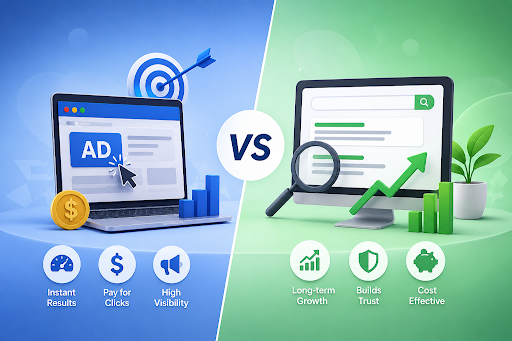
PPC vs SEO: A Side-by-Side Comparison
Here is a direct look at how the two channels stack up across the factors that matter most.
| Factor | PPC | SEO |
| Speed of results | Immediate, often same day | 3 to 12 months typically |
| Cost structure | Ongoing cost per click | Upfront time and content investment |
| Traffic durability | Stops when budget runs out | Continues to grow over time |
| Trust signal | Lower, labeled as ad | Higher, seen as earned authority |
| Best use case | Quick wins and product testing | Long-term brand and traffic growth |
| ROI over time | Consistent but cost-dependent | Compounds and improves over time |
| Data for optimization | Fast, real-time feedback | Slower but highly durable insights |
When PPC Makes More Sense for Your Business
New Businesses Without Any Organic Presence
If you just launched and have zero domain authority, SEO is going to take time. PPC gets you in front of your audience right away. Use that time to learn which keywords convert best, then build your SEO strategy around those winning terms.
Seasonal or Event-Based Businesses
If you run a tax prep service, a holiday gift shop, or any business with a clear peak season, PPC is a no-brainer. You can turn campaigns on and off exactly when you need them. Tools like Google Ads and Microsoft Advertising give you complete control over timing and budget.
When SEO Makes More Sense for Your Business
Established Businesses Looking to Reduce Ad Dependency
If you have been running PPC for a while and your cost-per-acquisition keeps climbing, that is a strong signal to double down on SEO. Organic traffic does not have a cost-per-click. Once you rank, those visits are free indefinitely.
Businesses in Niche Markets
If you serve a specific niche and keyword competition is low, SEO can get you to the top of results faster than in broader markets. A great example of this is the local SEO opportunity for service businesses where ranking for city-specific terms is often very achievable.
The Smartest Approach: Use PPC and SEO Together
Here is the real answer to the PPC vs SEO debate. The businesses that grow fastest use both, strategically. It is not about picking a winner. It is about knowing when each tool is the right one for the job.
- Use PPC to drive revenue while your SEO strategy builds momentum in the background
- Use PPC data to identify which keywords convert best, then target those organically
- Scale back PPC spend gradually as organic rankings improve to free up budget
- Run retargeting ads to re-engage organic visitors who did not convert the first time
- Use PPC during peak seasons and let SEO carry you through slower periods
How to Allocate Your Budget Between PPC and SEO
| Business Stage | Recommended PPC Split | Recommended SEO Split |
| Brand new, no organic traffic | 80% | 20% |
| Growing, building organic presence | 50% | 50% |
| Established with strong rankings | 30% | 70% |
| Mature brand, dominant organic presence | 15% | 85% |
As your organic traffic grows and your rankings stabilize, shift more budget away from PPC and into content creation, technical SEO, and link building. For help structuring that content investment, check out our eCommerce SEO guide which covers organic growth for product-based businesses specifically.
Frequently Asked Questions
Q1: Is PPC or SEO better for a brand new business?
A: PPC is generally the better starting point for brand new businesses that need immediate traffic and leads. It lets you validate your offer and learn which keywords convert before committing to a long-term SEO strategy. Most businesses benefit from doing both simultaneously once they have a baseline budget.
Q2: How much does PPC cost for a small US business?
A: There is no fixed cost, since PPC is a bidding system. Small businesses in the US typically spend anywhere from 500 dollars to 5,000 dollars per month on Google Ads depending on their industry and competition level. Some highly competitive industries like legal or insurance can cost significantly more per click.
Q3: Can I do SEO and PPC at the same time?
A: Yes, and it is highly recommended. Running both channels simultaneously lets you capture organic and paid traffic at the same time while also generating keyword and conversion data from PPC that directly improves your SEO strategy.
Q4: How long before SEO matches my PPC results?
A: This varies by industry and competition, but most businesses see organic traffic approach or exceed paid traffic levels within 12 to 18 months of consistent SEO investment. At that point, the cost efficiency of SEO typically outperforms PPC significantly.
Q5: Does running PPC ads help my organic SEO rankings?
A: Not directly. Google keeps paid and organic results completely separate in terms of ranking algorithms. However, PPC can indirectly help SEO by increasing brand awareness, driving direct searches for your brand name, and helping you identify the highest-converting content to create organically.
Making the Right Call for Your Business
The PPC vs SEO debate really comes down to your timeline, your budget, and your goals. PPC gives you speed and control. SEO gives you compounding returns and long-term credibility. The smartest marketers use both in a way that makes each channel stronger over time.
If you are just starting out, use PPC to get traction while you lay the groundwork for SEO. If you have been in business a while and want to reduce your dependence on paid advertising, double down on organic content and let it compound. Either way, the goal is the same: getting your business in front of the right people at the right time. Now you have the roadmap to do exactly that.