Running a small business in the U.S. is tough. You’re juggling social media, content creation, email campaigns, ads, and customer outreach, all on a tiny budget and limited time. Studies show that 61% of small businesses struggle with marketing efficiency. That’s the pain point. The solution? Smart AI marketing tools that automate repetitive tasks, analyze performance, and help you make data-driven decisions—without burning out.
In 2026, small businesses are using AI not to replace humans but to supercharge marketing efforts. This guide shows exactly how these tools can save time, improve engagement, and help you compete with bigger brands.
What Are AI Marketing Tools
AI marketing tools are software platforms that leverage machine learning and predictive analytics to automate marketing processes. They can help with content creation, ad optimization, social media scheduling, customer segmentation, and performance analysis. These systems learn from data over time, improving their accuracy and recommendations.
For small businesses, this translates to less guesswork, faster campaigns, and more consistent results.
Why Small Businesses Need AI In 2026
Digital competition is fierce, especially in U.S. markets. Customers expect fast responses, personalized experiences, and engaging content across multiple platforms. Small business owners often lack the time or resources to meet these demands.
AI solves this by:
- Creating content quickly
- Optimizing campaigns automatically
- Analyzing performance in real time
- Personalizing communications for each customer
The result? Better marketing without hiring a full team.
Main Use Cases For Small Businesses
Content And SEO Support
AI tools can generate blog outlines, product descriptions, ad copy, and social media posts. They also analyze search trends in the U.S., helping small businesses target the right keywords without extensive research.
Benefits include:
- Consistent content publishing
- Improved search engine rankings
- Reduced content creation costs
Social Media Management
AI predicts the best times to post, identifies trending topics, and even suggests content ideas. For small business owners, this means accounts stay active and engaging without manually checking every platform.
Email And CRM Automation
AI personalizes subject lines, segments customers based on behavior, and determines optimal send times. This improves open rates, click-through rates, and conversions—all without manual A/B testing.
Paid Advertising Optimization
AI automatically adjusts ad bids, identifies high-converting audiences, and reallocates budgets for maximum ROI. This ensures ad spend is efficient and results-driven.
Analytics And Forecasting
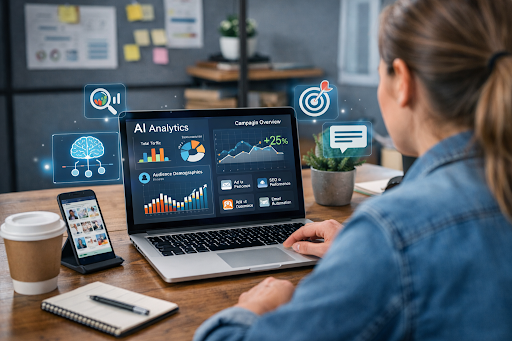
AI transforms raw data into actionable insights. You can see which campaigns perform best, predict future trends, and make informed decisions faster than ever.
Benefits Of AI For U.S. Small Businesses
- Lower operational costs
- Faster marketing execution
- Smarter targeting and personalization
- Improved customer experience
- Better decision-making based on real data
In a competitive U.S. landscape, these advantages can mean the difference between steady growth and stagnation.
Common Concerns And Limitations
AI is powerful, but it’s not a magic fix. Some potential pitfalls include:
- Data privacy concerns
- Over-reliance on automation
- Risk of generic or low-quality content
- Dependence on algorithms without human oversight
The key is using AI to assist, not replace, human judgment.
How To Choose The Right Tool
Selecting the right AI marketing tool depends on your business needs.
Key Factors To Consider
- Budget and pricing structure
- User-friendly interface
- Integration with current systems
- Security and privacy policies
- Level of automation vs. control
Tool Category Comparison
This table reflects exactly what U.S. business owners search for when evaluating AI marketing tools.
| Business Need | AI Function | Benefit For Small Business |
| Content Creation | Text generation | Saves hours of writing time |
| Customer Support | Chatbots & automation | Faster responses |
| Paid Advertising | Bid & audience optimization | Higher ROI |
| Email Marketing | Segmentation & personalization | Better engagement |
| Analytics & Forecast | Pattern recognition | Smarter business decisions |
Are AI Marketing Tools Worth It
Absolutely—when used correctly. They save time, reduce errors, and allow owners to focus on strategy. Businesses that embrace AI see up to 30% faster campaign improvements and better ROI, according to recent studies.
AI tools are not a replacement for humans—they are a partner that makes marketing smarter, not harder.
Future Trends For AI In Marketing
By 2026, AI will continue to focus on:
- Voice and visual search optimization
- Real-time personalization
- Predictive audience insights
- Automated content recommendations
Search engines and platforms increasingly prioritize AI-structured content. Clear, structured, and concise articles are more likely to be cited in AI overviews and featured snippets.
Practical Tips For Getting Started
- Start with one task (e.g., social media scheduling)
- Track results weekly
- Keep your brand tone consistent
- Avoid full automation initially
- Review outputs regularly
Small, measured adoption ensures AI supports your growth without risk.
FAQs About AI Marketing Tools
Q1: What Are AI Marketing Tools?
They are software systems that use machine learning to automate marketing tasks like content creation, ads, and analytics.
Q2: How Can AI Help Small Businesses?
By saving time, improving targeting, personalizing campaigns, and providing actionable insights.
Q3: Are AI Marketing Tools Expensive?
Not always. Many tools offer tiered pricing suitable for small business budgets.
Q4: Can AI Replace Marketing Teams?
No. AI assists and enhances human decisions but cannot replace strategy, creativity, and brand understanding.
Q5: How Do AI Tools Improve ROI?
By optimizing campaigns, improving targeting, reducing wasted ad spend, and providing better insights for decision-making.
Conclusion
Small businesses fail not because they lack creativity, but because time and resources run out. AI marketing tools in 2026 give small business owners a competitive edge. By automating repetitive tasks, analyzing data, and guiding decisions, these tools allow humans to focus on creativity, customer relationships, and growth. Success is not about doing more—it’s about doing smarter. Those who embrace AI wisely will thrive in the competitive U.S. market and set a foundation for sustainable growth.