Search doesn’t look the way it did two years ago. On a growing share of queries, Google now answers people directly inside an AI-generated summary before a single blue link ever loads. ChatGPT, Perplexity, and Gemini have turned into everyday research tools in their own right. For a business owner, that raises one uncomfortable question: if an AI system answers the question, does your website even get seen?
This is what people mean when they talk about AI SEO — the practice of optimizing your content so it gets pulled into AI Overviews, AI Mode, and chatbot answers, not just the traditional ten blue links. In May 2026, Google published its first official guide dedicated to this exact topic, which finally cleared up a lot of guesswork the SEO industry had been running on. This article breaks down what actually matters, what you can stop worrying about, and the concrete steps to take this month.
What Is AI SEO?
AI SEO is the process of structuring and strengthening your website so it can be found, understood, and cited by AI-powered search experiences — including Google AI Overviews, Google AI Mode, and answers generated by tools like ChatGPT and Perplexity. You may also see it called Answer Engine Optimization (AEO) or Generative Engine Optimization (GEO); in practice, the three terms overlap heavily and describe the same underlying goal: earning a place inside an AI-written answer, not just a ranking position beneath it.
AI SEO is not a replacement for traditional SEO. It’s built on top of it. As Google explains in its official guidance on AI features and your website, to be eligible for an AI Overview citation, a page generally needs to already be capable of ranking well in traditional organic search. If your foundational SEO is weak, no amount of “AI-specific” formatting will fix that.
Why AI SEO Matters More in 2026
The numbers explain why this shift is impossible to ignore. AI Overviews now appear on roughly half of all Google searches, up sharply from a year earlier, and Google AI Mode has passed 100 million monthly active users. Across all query types, a majority of Google searches now end without a single click to any website, and that zero-click rate climbs even higher on the specific queries that trigger an AI Overview.
That sounds discouraging, but it’s not the full picture. Visitors who do click through from an AI Overview tend to arrive further along in their decision, which generally means better engagement and stronger conversion rates than a typical top-of-funnel visitor. Being cited by name inside an AI answer also builds brand recognition even when the user never clicks — and branded searches for your company tend to convert at a noticeably higher rate than generic organic traffic. In short: fewer total clicks, but the clicks and impressions that remain carry more weight.
How Google AI Overviews Actually Choose Sources
Google’s official AI optimization guide confirms that AI Overviews and AI Mode draw from the same search index used for standard results — there’s no separate database or secret submission process. A large majority of AI Overview citations go to pages that already rank in the top 10 organic results for that query, which means the fastest way to improve your AI visibility is usually to improve your traditional ranking first. If your rankings have stalled, it’s worth reading our breakdown of why SEO stops working after months of effort before layering AI-specific tactics on top.
From there, source selection leans heavily on Google’s long-standing E-E-A-T framework — Experience, Expertise, Authoritativeness, and Trustworthiness. Content written with first-hand experience, backed by clear sourcing, and published under an identifiable author or brand is far more likely to be pulled into a generated answer than generic, unattributed content. This is exactly the gap our content writing services are built to close for clients.
AI SEO Myths You Can Stop Worrying About
Google’s May 2026 documentation directly addressed several tactics that had become popular guesswork in the SEO community. A few are worth retiring:
- llms.txt files. Google’s crawlers may discover this file, but it receives no special treatment or preferred indexing status.
- Content chunking. You do not need to break articles into short, isolated fragments. Google’s systems can understand multi-topic pages and extract the relevant passage on their own.
- Treating AEO as an entirely separate discipline from SEO. There are no additional technical requirements to appear in AI Overviews beyond solid, standard SEO practice.
This matters because it means you don’t need a parallel content strategy. You need a stronger version of the SEO strategy you likely already have.
7 Practical AI SEO Strategies for 2026
1. Lead with a direct answer
AI systems extract discrete, well-defined claims from a page. Open each section with a clear, self-contained answer in the first sentence or two, then expand with supporting detail, examples, and nuance underneath.
2. Write for full questions, not fragments
People increasingly type or speak full questions into search. Instead of writing around a short phrase like “AI SEO tips,” structure headings around how people actually ask the question, such as “How do I get my content cited in Google AI Overviews?”
3. Strengthen E-E-A-T signals
Add clear author bylines, cite original data or first-hand experience, and make sure your site’s About page and credentials are easy to find. This is one of the areas Google has emphasized most consistently across its 2026 guidance.
4. Use structured data
Schema markup won’t guarantee an AI citation on its own, but it makes your content easier to parse correctly and remains a reliable way to improve visibility and click-through rate across both traditional and AI-powered results. This is one of the technical items our SEO services team checks first during a site audit.
5. Build a genuine internal linking structure
Clear internal links help both users and crawlers move logically between related pages, reinforcing topical authority. If you’ve already published supporting content — for example our guide on why a website isn’t getting organic traffic — link it back to your core service pages so both users and crawlers can trace the connection.
6. Keep technical SEO fundamentals tight
Fast load times, mobile-friendly design, and clean crawlability remain prerequisites, not extras. A page has to be indexed and competitive in standard search before it can realistically earn an AI citation. If your site is on WordPress and still feels slow, our guide on making a WordPress site load faster without hiring a developer walks through the fixes that matter most.
7. Track citations, not just rankings
Use the Generative AI performance report inside Google Search Console to see how your pages are being surfaced in AI features. Pair that with a monthly manual check: search your target queries yourself and note which competitors are getting cited.
AI SEO vs. Traditional SEO vs. GEO
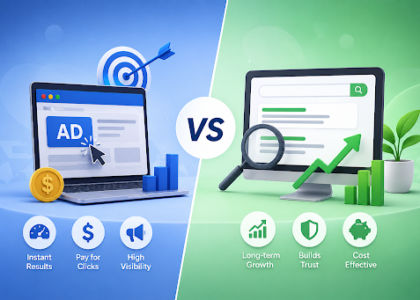
Traditional SEO is about earning a ranking position in the list of links below an AI Overview. AI SEO (or GEO) is about earning a citation inside the generated answer itself. In 2026, treating these as competing priorities is usually the wrong framing — most of what improves one also improves the other. Where they diverge is emphasis: GEO leans harder on being quotable in a single sentence and on maintaining a consistent, authoritative presence across the wider web, including forums, review sites, and other platforms AI systems draw from beyond your own website.
How to Measure AI SEO Success
Start with the Generative AI performance report in Search Console, which shows impressions and clicks specifically tied to AI features. Supplement it with a simple monthly audit: pick your ten highest-traffic informational pages, search their target queries in an incognito window, and record whether your site appears in the AI-generated answer and which competitors do. Larger teams sometimes add dedicated AI-visibility tracking tools, but a spreadsheet and a bit of discipline will get most small and mid-sized sites most of the way there.
Common AI SEO Mistakes to Avoid
Most AI SEO failures aren’t caused by missing some obscure technical trick — they’re caused by skipping the fundamentals while chasing shortcuts, a pattern we’ve also seen behind the Google May 2026 core update’s impact on small websites. Here are the mistakes we see most often:
- Chasing every new “AI SEO hack” instead of strengthening core content quality and technical SEO.
- Publishing thin, generic content without original data, examples, or clear authorship.
- Ignoring structured data and basic technical hygiene.
- Expecting results within days — AI visibility follows the same patience curve as traditional SEO.
- Optimizing only for primary keywords instead of covering a topic comprehensively.
Frequently Asked Questions
Is AI SEO different from traditional SEO?
Not fundamentally. AI SEO builds on the same foundations as traditional SEO — quality content, technical health, and authority — with extra emphasis on direct, well-structured answers and demonstrable expertise.
Do I need an llms.txt file to rank in AI Overviews?
No. Google has confirmed this file receives no special treatment in its search or AI systems.
Will AI Overviews reduce my website traffic?
Total click volume can drop for purely informational queries, but traffic quality often improves, since users who do click through tend to have higher intent.
How long does it take to see results from AI SEO?
Similar to traditional SEO, expect weeks to months rather than days. Google needs to index and re-evaluate your content before it can consistently surface in AI-generated answers, and improvements tend to compound as your overall site authority grows.
Should small businesses bother with AI SEO in 2026?
Yes, especially local and service businesses. AI Overviews and AI Mode surface local information, reviews, and business details prominently, which gives smaller, well-optimized sites a genuine opportunity to appear alongside much larger competitors.
Final Thoughts
AI SEO in 2026 isn’t a separate game — it’s the next layer on top of the SEO fundamentals that have always mattered: helpful content, technical health, and real authority. If your site isn’t showing up in either traditional results or AI-generated answers, the underlying cause is usually the same, and fixing it improves both at once.
If you’d rather have a team handle this end to end, get in touch with Tech Tribe Magazine and we’ll audit where your site stands today.