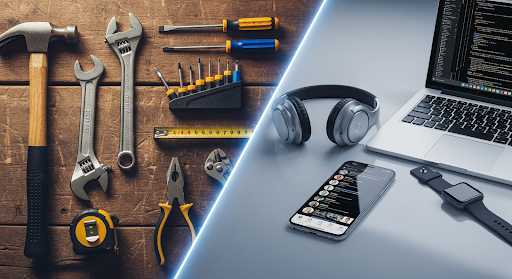
People mix up tools and tech all the time. That confusion causes bad buying decisions, wasted training hours, and a lot of “why is this so complicated” frustration at work and in school. The fix is simple. Learn how tools and technology differ, how they work together, and when you actually need one over the other.
What Is A Tool?
A tool is anything designed to help you complete a task directly. It usually needs human effort to work and does exactly what the user tells it to do.
Think basic, hands-on, and task-focused.
A hammer drives a nail.
A calculator solves a math problem when you punch in numbers.
A spreadsheet helps you organize data if you set it up correctly.
Tools do not think, adapt, or improve on their own. They wait for input and respond in predictable ways.
Common Characteristics Of Tools
- Require direct human control
- Perform a specific task
- Do not operate independently
- Usually easy to learn
In the US workplace, tools show up everywhere. From tape measures on construction sites to Excel sheets in corporate offices, they are the backbone of daily productivity.
What Is Technology?
Technology is a broader system that uses tools, processes, data, and sometimes automation to solve problems at scale.
Technology often works in the background. It reduces effort, speeds things up, and can adapt based on data.
For example, GPS navigation is a technology. It uses satellites, software, algorithms, and devices to guide you without manual calculation. Cloud computing is a technology. You do not manage servers yourself, yet everything runs smoothly.
Technology does more than help. It changes how tasks are done entirely.
Common Characteristics Of Technology
- Combines multiple tools and systems
- Can automate tasks
- Often adapts or updates over time
- Reduces manual effort
In the US, technology shapes everything from online banking to remote healthcare visits. It is not just about convenience. It is about efficiency and scale.
Key Differences Between Tools And Technology
Here is where most people get tripped up. A tool can exist without advanced technology. Technology almost always includes tools.
| Aspect | Tool | Technology |
| Purpose | Completes a specific task | Solves broader problems |
| Human Input | Required at all times | Often reduced |
| Complexity | Simple to moderate | Moderate to complex |
| Adaptability | Fixed | Can evolve |
A screwdriver tightens a screw. A power drill uses electrical systems, design engineering, and software in some cases. The drill is technology. The screwdriver is a tool.
Understanding this difference helps businesses choose smarter systems and helps individuals learn skills that actually matter.
Real World Examples You See Every Day
In education, a textbook is a tool. An online learning platform that tracks progress, adjusts lessons, and sends reminders is technology.
In healthcare, a stethoscope is a tool. Electronic health record systems that store data, flag risks, and share information across providers are technology.
In retail, a cash register is a tool. A point-of-sale system that manages inventory, analyzes buying habits, and syncs with accounting software is technology.
This is why people often talk about tools and technology together. They work best as a team, not as competitors.
Why The Difference Matters More Than You Think
When people treat technology like a simple tool, they underuse it. When they expect a tool to behave like technology, they get disappointed.
In US businesses, this confusion leads to expensive software that no one fully adopts. In classrooms, it leads to students relying on apps without understanding fundamentals.
Knowing the difference helps you:
- Choose the right solution for the job
- Train people properly
- Avoid overcomplicating simple tasks
- Get better returns on time and money
It also makes conversations at work clearer. No more vague talk about “adding tech” when a basic tool would do the trick.
How Tools And Technology Work Best Together
The sweet spot is not choosing one over the other. It is knowing how to combine them.
A graphic designer still needs creative tools like sketching and layout skills. Design software enhances those tools with speed and flexibility.
A mechanic still uses hand tools. Diagnostic technology helps identify problems faster.
This balance is what keeps systems human-friendly while still powerful.
Conclusion
Confusing tools with technology is an easy mistake, but it comes at a real cost. Once you understand the difference, decisions get clearer, and work gets smoother. Tools help you act. Technology helps systems think and scale. When you know which one you need and when, you stop fighting complexity and start using it to your advantage.