Latest Emerging Technologies in IT & AI Shaping 2026
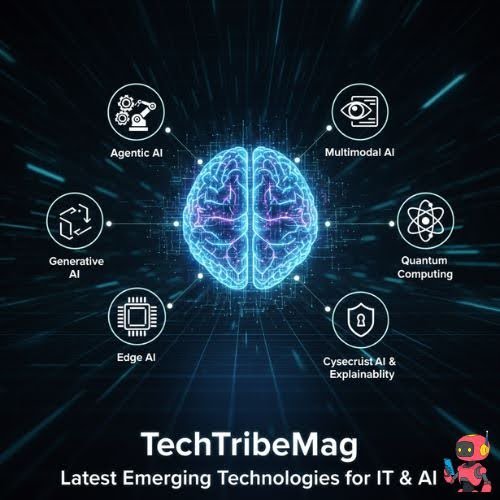
The rapid evolution of information technology and artificial intelligence is transforming how industries operate, innovate, and compete. By 2026, emerging IT and AI technologies such as agentic AI, quantum computing, edge intelligence, and multimodal systems are redefining efficiency, automation, and decision-making across sectors. These advancements are not incremental—they represent a fundamental shift toward autonomous, intelligent, and ethical digital ecosystems.
Businesses that understand and adopt these technologies early are positioning themselves for long-term success in an increasingly hyper-connected world.
Agentic AI: Autonomous Intelligence at Scale
Agentic AI marks a major leap beyond traditional AI models. These systems are capable of autonomous planning, decision-making, and task execution without continuous human intervention. Unlike reactive AI, agentic systems break complex objectives into smaller tasks and dynamically use tools such as APIs, databases, and external software to achieve goals.
In IT operations, agentic AI is transforming DevOps by automating pipelines, predicting infrastructure failures, and deploying fixes proactively—reducing downtime significantly. Cybersecurity teams benefit from autonomous agents that detect threats, correlate anomalies, and isolate breaches within seconds. Healthcare applications are also expanding, with agentic AI personalizing treatment plans using real-time patient data.
Memory-augmented agents further enhance performance by learning from past interactions, enabling continuous improvement over time. While scalability remains a challenge, hybrid cloud architectures are making enterprise-level adoption increasingly feasible.
Multimodal AI: Connecting Text, Vision, and Sound
Multimodal AI enables systems to process and understand multiple data types simultaneously, including text, images, audio, and video. This capability unlocks deeper insights and more intuitive IT applications. From generating code based on visual sketches to automating UI testing, multimodal systems are reshaping software development and enterprise workflows.
One major advancement is retrieval-augmented generation (RAG), which grounds AI outputs in proprietary or enterprise data, significantly reducing hallucinations. In e-commerce and digital platforms, multimodal AI analyzes user-uploaded images and behavior to deliver highly personalized recommendations, improving engagement and conversion rates.
Lightweight multimodal models now run efficiently on edge devices, supporting real-time AR and VR experiences without heavy cloud reliance. Future developments may integrate additional sensory inputs, expanding applications in robotics and immersive environments.
Quantum Computing: Unlocking New Computational Frontiers
Quantum computing is poised to solve problems beyond the reach of classical computers by leveraging qubits and parallel processing. Recent breakthroughs in error-corrected quantum systems are enabling practical applications in AI training, optimization, and simulation.
In IT and enterprise environments, quantum algorithms dramatically reduce computation times for logistics optimization, financial modeling, and risk analysis. Quantum machine learning accelerates pattern recognition in complex datasets, making it valuable for fraud detection and predictive analytics.
Hybrid quantum-classical models and cloud-based access are helping overcome challenges such as decoherence, bringing quantum-powered AI closer to real-world deployment. One of the most promising use cases lies in drug discovery, where molecular simulations can be performed with unprecedented precision.
Edge AI and Neuromorphic Hardware
Edge AI shifts intelligence closer to data sources, reducing latency and improving privacy. This is critical for IoT ecosystems, autonomous vehicles, and smart manufacturing. Neuromorphic chips, inspired by the human brain, enable energy-efficient processing through spiking neural networks.
These systems excel in real-time learning and adaptive environments. In smart cities, edge AI processes traffic and surveillance data instantly, improving congestion management and public safety. Combined with next-generation networks like 6G, edge intelligence supports massive device coordination while keeping sensitive data local.
Generative AI: Beyond Text Creation
Generative AI has evolved from basic text generation into a powerful creative engine capable of producing realistic images, videos, and simulations. Advanced diffusion models are now used for synthetic data generation, allowing organizations to train AI models without exposing sensitive information.
Small language models (SLMs) bring generative AI to mobile and offline environments, enabling on-device assistance and faster response times. In software development, generative AI accelerates coding, testing, and localization, significantly reducing development cycles.
As generative capabilities expand, ethical safeguards such as watermarking, content verification, and responsible AI policies are becoming essential to address misinformation and deepfake risks.
AI-Driven Cybersecurity and Ethical Intelligence
Cybersecurity is being reinvented through AI-powered zero-trust frameworks that continuously verify users and devices. Behavioral analytics and unsupervised learning models identify threats that traditional rule-based systems often miss.
At the same time, ethical AI and explainability are gaining importance. Explainable AI techniques help organizations understand model decisions, while bias detection tools ensure fairness and compliance. Global regulations are pushing for transparency, accountability, and sustainable AI practices.
Federated learning and energy-efficient architectures further support responsible innovation by minimizing data exposure and environmental impact.
The Future of IT Infrastructure
Modern IT infrastructure is becoming modular and intelligent. Composable systems allow resources to be dynamically pooled and allocated, while AI-driven orchestration ensures optimal performance. Serverless computing with automated scaling handles unpredictable workloads effortlessly.
Digital twins simulate real-world systems, enabling organizations to test scenarios, optimize operations, and reduce risk before implementation.
Conclusion: Building the Intelligent Future
The latest emerging technologies in IT and AI—from autonomous agents and quantum computing to edge intelligence and ethical frameworks—are reshaping the digital landscape. These innovations are not just tools; they are catalysts driving efficiency, creativity, and smarter decision-making across industries.
Organizations that invest in skills, infrastructure, and responsible adoption today will lead tomorrow’s competitive landscape. As these technologies mature, collaboration and innovation will define the next era of intelligent transformation.
For More Info Visit:- techtribemag.com