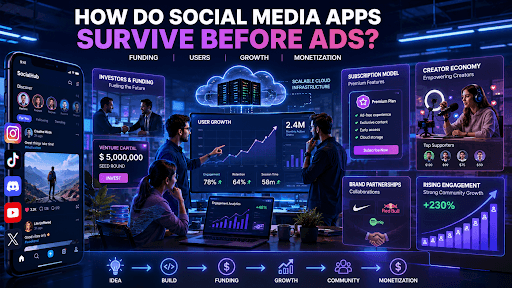
Social media platforms are everywhere today. From Facebook and Instagram to TikTok and Snapchat, most people assume these apps make billions only through advertisements. But have you ever wondered: How Do Social Media Apps Survive Before Ads start generating revenue?
This is one of the most interesting questions in the tech industry. Before social media companies earn money from advertisers, they still need to pay developers, servers, designers, marketing teams, and operational costs. Yet many startups survive for years without showing a single advertisement.
In this blog, we’ll explain How Do Social Media Apps Survive Before Ads, what strategies they use, how investors support them, and why user growth matters more than immediate profits.
Why Social Media Apps Focus on Users Before Money
Most social media startups do not focus on profits in the beginning. Their primary goal is simple:
- Increase users
- Improve engagement
- Build trust
- Create daily habits
Investors and founders know that if millions of users spend hours on an app every day, monetization opportunities will naturally come later.
For example, WhatsApp became globally popular before introducing business features. Similarly, Instagram focused heavily on user experience before running large-scale ads.
The logic is straightforward:
No users = No advertisers.
That’s why companies first build a strong audience and then focus on revenue generation.
1. Venture Capital Funding
The biggest answer to How Do Social Media Apps Survive Before Ads is venture capital funding.
Investors provide millions — sometimes billions — of dollars to promising startups because they believe the platform will become profitable in the future.
How Venture Capital Works
Investors give money in exchange for ownership shares in the company. If the app becomes successful later, their shares become highly valuable.
For example:
- Early investors in Facebook earned massive returns after its growth.
- Snapchat received huge investments even before stable profits.
- TikTok expanded rapidly with strong financial backing.
This funding helps startups cover:
- Employee salaries
- App development
- Cloud hosting
- Marketing campaigns
- Security systems
- Content moderation
Without venture capital, many social media platforms would struggle to survive in their early stages.
2. Angel Investors and Seed Funding
Before venture capital arrives, many apps depend on angel investors.
Angel investors are wealthy individuals who invest in startups at an early stage. They believe in the founder’s vision and provide initial funding.
This early investment is called:
- Seed funding
- Pre-seed funding
This money helps social media apps:
- Build MVPs (Minimum Viable Products)
- Hire small teams
- Launch beta versions
- Test market demand
Many successful companies started this way before becoming billion-dollar businesses.
3. Subscription-Based Models
Some social media apps survive before ads by offering premium subscriptions.
Instead of relying on advertisers, they charge users for extra features.
Examples include:
- Premium memberships
- Exclusive creator tools
- Ad-free experiences
- Enhanced privacy
- Cloud storage
Apps like Discord use premium subscriptions such as Nitro to generate income early.
This strategy works especially well when users strongly value the platform experience.
4. Freemium Features
Another important answer to How Do Social Media Apps Survive Before Ads is the freemium business model.
Freemium means:
- Basic features are free
- Advanced features are paid
This helps apps grow rapidly while still generating some revenue.
Popular freemium features include:
- Custom profiles
- Verification badges
- Advanced analytics
- Extra uploads
- Priority support
This strategy balances user growth with sustainability.
5. Partnerships and Sponsorships
Some social media startups partner with brands before launching official advertisements.
These partnerships may include:
- Sponsored content
- Brand collaborations
- Influencer campaigns
- Event promotions
For example, a fitness app may collaborate with sports brands or creators to generate early revenue without traditional ads.
This allows startups to survive while maintaining a cleaner user experience.
6. Selling Data Insights (Ethically)
Data analytics also play a role in how social media companies survive.
Apps collect valuable information about:
- User behavior
- Trends
- Engagement patterns
- Consumer interests
Companies can use anonymized analytics to:
- Improve algorithms
- Offer business insights
- Help brands understand audiences
However, privacy laws today are much stricter, so ethical data handling is extremely important.
Users now expect transparency regarding data usage.
7. Parent Company Support
Some apps survive because they are owned by larger companies.
For example:
- Instagram was acquired by Meta
- YouTube is owned by Google
Large parent companies provide:
- Financial support
- Infrastructure
- Technical resources
- Marketing power
This allows platforms to focus on growth instead of immediate profitability.
8. Building Network Effects
One major reason investors support social media apps is network effects.
A network effect means:
The app becomes more valuable as more people join it.
Examples:
- More friends on a platform increase engagement
- More creators attract more viewers
- More viewers attract more creators
This creates exponential growth.
Apps that achieve strong network effects can later dominate the market and generate massive ad revenue.
9. Creator Economy and Monetization Tools
Modern social media platforms increasingly survive through creator-focused monetization.
Instead of ads, they earn through:
- Creator subscriptions
- Virtual gifts
- Paid live streams
- Revenue sharing
- Digital tipping
Platforms like TikTok and YouTube heavily benefit from creator ecosystems.
Creators attract audiences, and audiences attract future monetization opportunities.
10. Why Investors Don’t Worry About Early Losses
Many people ask:
“Why would investors support companies that lose money?”
The answer is scalability.
Social media apps can grow extremely fast once they gain traction.
A platform with millions of daily active users can later generate revenue through:
- Ads
- E-commerce
- Subscriptions
- AI tools
- Premium services
- Business accounts
Investors prioritize:
- User retention
- Engagement time
- Monthly active users
- Viral growth
If these numbers are strong, future profitability becomes likely.
Real Examples of Social Media Growth Before Ads
Initially focused on clean messaging without ads. Growth came first, monetization later through business tools.
Focused on user engagement and photo-sharing simplicity before introducing sponsored posts.
TikTok
Expanded globally with aggressive investment and creator-focused growth strategies.
Discord
Built loyal communities using premium subscriptions instead of relying heavily on ads.
Challenges Social Media Apps Face Before Ads
Even with funding, survival is difficult.
Major challenges include:
- High server costs
- Competition
- User retention
- Cybersecurity
- Content moderation
- Legal compliance
Apps must constantly innovate to keep users active.
Without engagement, even heavily funded startups can fail.
The Future of Social Media Monetization
The future may rely less on traditional advertising and more on:
- AI-powered tools
- Creator economies
- Virtual goods
- Digital communities
- Subscription ecosystems
Users increasingly dislike intrusive ads, so platforms are exploring smarter monetization strategies.
This shift could redefine how social media businesses operate in the coming years.
Final Thoughts
So, How Do Social Media Apps Survive Before Ads?
The answer involves multiple strategies:
- Venture capital funding
- Angel investors
- Premium subscriptions
- Partnerships
- Freemium models
- Creator monetization
- Parent company support
Most importantly, social media companies prioritize building massive user communities first. Once they gain attention, engagement, and loyalty, monetization opportunities naturally follow.
In today’s digital economy, user attention is one of the most valuable assets. That’s why investors are willing to fund social media apps long before advertisements appear.
If a platform successfully captures millions of active users, ads eventually become only one of many possible revenue streams.
For More Info Visit:- techtribemag.com