In today’s fast-moving digital world, businesses rely heavily on technology to streamline operations, improve customer experience, and stay competitive. While ready-made software solutions may seem convenient, they often fail to address specific business needs. This is where custom software becomes essential. Custom software is designed specifically for a company’s workflow, goals, and challenges, offering long-term value and flexibility.
This blog explains what custom software is, how it works, its benefits, industries that use it, and how businesses can choose the right development approach.
What Is Custom Software Development?
Custom software development is the process of designing, building, deploying, and maintaining software tailored to a specific organization’s requirements. Unlike off-the-shelf software, custom solutions are created to align perfectly with a company’s processes, users, and long-term goals.
Businesses choose Custom software development services when they need unique features, better performance, stronger security, or seamless integration with existing systems. These solutions are built from scratch or customized extensively to meet exact specifications.
Why Businesses Need Custom Software Solutions
Every business operates differently. Pre-built software often includes unnecessary features while missing critical ones. Custom software fills this gap by offering precision and adaptability.
Key reasons businesses choose custom software include:
- Unique business workflows that standard tools cannot support
- Need for scalability as the company grows
- Data security and compliance requirements
- Integration with existing systems and tools
- Competitive advantage through innovation
Custom software evolves with the business instead of forcing the business to adapt to software limitations.
Types of Custom Software Solutions
Custom software can be developed for various platforms and purposes depending on business needs.
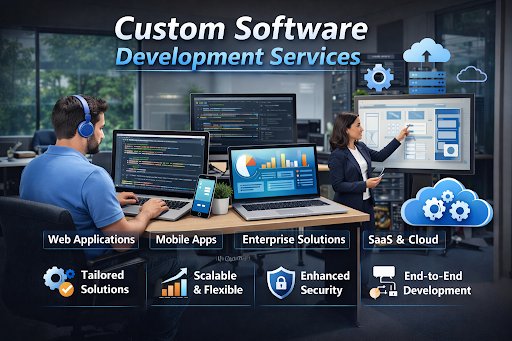
1. Web-Based Applications
Web applications are accessible through browsers and are ideal for businesses that need centralized access across locations. Examples include CRM systems, ERP platforms, and customer portals.
2. Mobile Applications
Custom mobile apps are designed for Android, iOS, or both. These apps improve customer engagement, enable remote work, and support on-the-go operations.
3. Enterprise Software
Enterprise solutions manage large-scale business processes such as finance, human resources, inventory, and analytics.
4. Cloud-Based Software
Cloud solutions offer scalability, remote accessibility, and cost efficiency. Many modern custom solutions are built using cloud infrastructure.
Benefits of Custom Software Development
Custom software offers advantages that generic software cannot match.
Tailored Functionality
The software is designed specifically for your business needs, ensuring every feature serves a purpose.
Scalability
Custom solutions can grow alongside your business without major rework or performance issues.
Better Security
Security measures are built according to your industry standards, reducing vulnerabilities common in mass-market software.
Seamless Integration
Custom software easily integrates with existing systems such as payment gateways, accounting tools, or databases.
Long-Term Cost Efficiency
While initial development costs may be higher, custom software reduces licensing fees and inefficiencies over time.
Custom Software Development Process
A structured development process ensures high-quality results.
Requirement Analysis
Developers gather detailed information about business goals, users, and technical requirements.
Planning and Design
Wireframes, UI/UX designs, and technical architecture are created before development begins.
Development
Developers write clean, scalable code using suitable programming languages and frameworks.
Testing
The software is tested for functionality, security, performance, and usability.
Deployment and Maintenance
Once launched, the software is monitored, updated, and improved regularly.
Industries That Use Custom Software
Custom software is widely used across industries.
- Healthcare: patient management systems, telemedicine platforms
- Finance: fintech apps, secure transaction systems
- E-commerce: custom shopping platforms and inventory tools
- Education: learning management systems
- Manufacturing: automation and supply chain software
- Logistics: tracking and fleet management systems
Each industry benefits from solutions built specifically for its regulations and workflows.
Custom Software vs Off-the-Shelf Software
| Feature | Custom Software | Off-the-Shelf Software |
| Customization | Fully customizable | Limited |
| Scalability | High | Restricted |
| Cost | Higher initial | Lower upfront |
| Security | Tailored | General |
| Ownership | Full | License-based |
Custom software is ideal for businesses seeking long-term growth and flexibility.
Choosing the Right Development Partner
Selecting the right development team is crucial for success.
Consider these factors:
- Experience in your industry
- Strong portfolio and case studies
- Clear communication and transparency
- Post-launch support and maintenance
- Understanding of security and compliance
A reliable partner ensures smooth execution from idea to deployment.
Future of Custom Software Development
With the rise of AI, machine learning, IoT, and automation, custom software is becoming more advanced and intelligent. Businesses are investing in solutions that offer predictive analytics, real-time insights, and personalized user experiences.
As digital transformation continues, demand for tailored software solutions will keep growing across industries.
FAQs: Custom Software Development Services
1. What are custom software development services?
Custom software development services involve designing and building software tailored to a specific business’s needs, workflows, and objectives instead of using pre-made solutions.
2. How long does custom software development take?
The timeline depends on project complexity, features, and integrations. Simple projects may take a few months, while complex systems can take longer.
3. Is custom software expensive?
Initial costs may be higher than off-the-shelf software, but custom solutions offer better ROI by reducing inefficiencies and long-term licensing costs.
4. Can custom software be updated later?
Yes. One of the biggest advantages of custom software is flexibility. Features can be added or modified as business needs change.
5. Which businesses should invest in custom software?
Businesses with unique processes, scalability needs, security concerns, or long-term growth plans benefit the most from custom software.
Conclusion
Custom software empowers businesses to work smarter, faster, and more securely. By investing in solutions designed specifically for their needs, organizations gain better control, scalability, and efficiency. Whether you are a startup or an established enterprise, choosing the right approach to custom software development can transform your operations and support long-term success.
For More Info Visit:- techtribemag.com